John Johanna’s Telescope

There’s nothing explicitly about science in the songs on The Anthology of American Folk Music, even though I’ve named this science/music blog after an illustration on The Anthology’s cover.

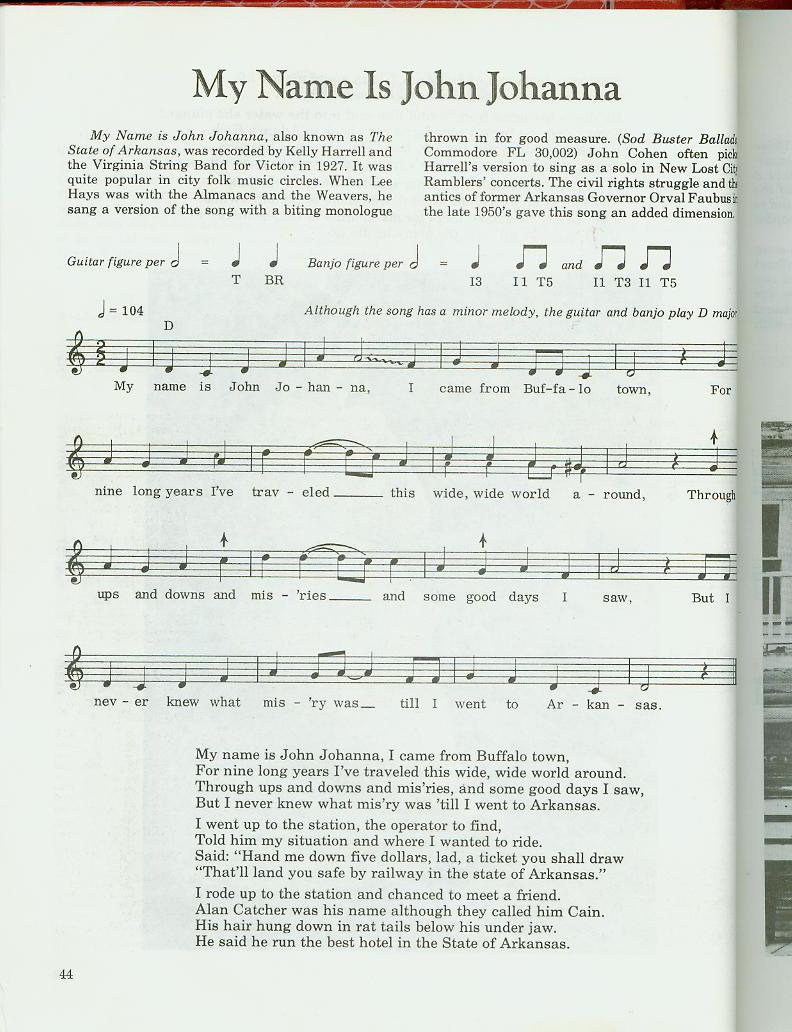
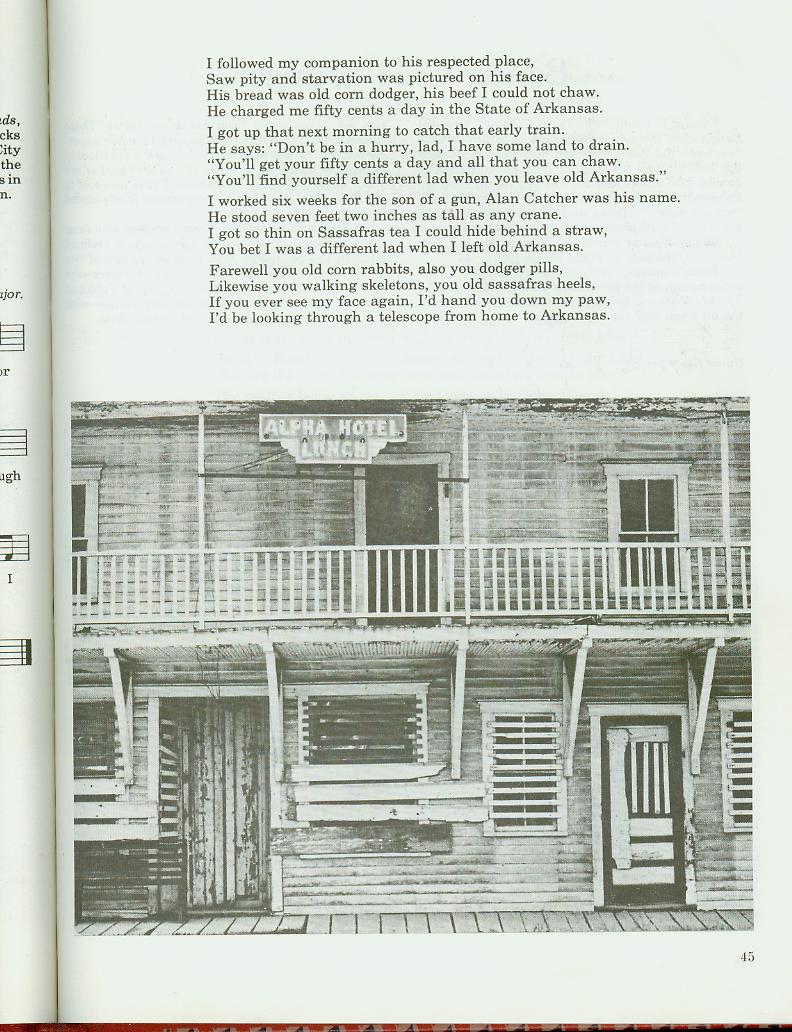
The closest thing to an exception I can recall is Kelly Harrell’s “My Name is John Johanna,” a song about what a rotten place Arkansas is ( … alleged to be). After listing the horrors he witnessed there, the singer vows that if he ever sees Arkansas again, it’ll be through a telescope.

It’s a funny line to me, I suppose partly because I’m used to thinking of telescopes as a way of overcoming distance, not of enforcing it.

For lyrics, see Page 1 and Page 2.

Dreaming of the Hillbilly Blues

In the early stages of my … condition, I had a CD changer that held six CDs. I’d put the entire Anthology of American Folk Music on repeat, place a speaker next to my pillow (since the original 78s were in mono, one speaker would suffice), and just let The Anthology seep all the way deep down into my skull while I slept, soaking the reptilian core of my brainstem, all night long, every night, for months. After a while, I expected Amnesty International to break down my door.

The next CD I bought after The Anthology was Dock Boggs’ 1960’s recordings. I brought it home, put it on the stereo, and when “New Prisoner’s Song” came on, I burst into tears, just sobbed openly for a while … until I suddenly thought, “My musical tastes have CHANGED.” Maybe it was like admitting to yourself for the first time that you’re gay — realizing you’re someone other than who you thought you were. I mean, what should I tell the wife? The judge will surely side with HER! You should really be careful what music you mainline directly into your subconscious.

Years later, I hit the bunk in the army barracks at American Banjo Camp, at 2 in the morning, a little whiskey in me, after five hours of jamming and listening in on jams … fiddles, guitars, accordions, two doghouse basses, three dozen banjos. I slept like the dead, so deep and contented, drifting off with the sound-memory of old-time music so bright and benevolent and everlasting inside my head … Brilliancy Medley, June Apple, Sally in the Garden, Ducks on the Millpond, Whiskey Before Breakfast, Soldier’s Joy, Sail Away Ladies, Liberty, Devil’s Dream …

 

Well May the World Go

I hear an astronaut’s folk song

Of course, maybe it’s me … I can’t help but hear Pete Seeger’s “Well May the World Go (When I’m Far Away)” as at least two songs in one. Is the narrator of “Well May the World Go” about to die? Or is he an astronaut? After all, Seeger based the song on an old Scottish tune (maybe a sea chantey) called “Weel May the Keel Row,” which bids a bon voyage. Was Seeger thinking of death or space travel when he decided “The World” would somehow stay behind?

To my ears, “Well May the World Go” is a fine anthem for NASA’s manned space program. The song’s aims are like those of the program I thought I knew as a youngster – to reintroduce us to our own planet as a beautiful place, to collapse vast distances, to wish the world well. NASA still seems to want to be seen this way, and many of its employees are kids like me who never fully grew up. “Well May the World Go” still lurks somewhere in the gaps of NASA’s bureaucracy.

So why not really adopt the song as an official anthem? The trouble, from NASA’s point of view, would not just be that Pete Seeger has always been a proud resident of the blacklist and a sworn enemy of American missiles. The still bigger problem would be that the song is too apt. The manned space program has come to be haunted by Death, always there on the buffalo side of the coin. Many of us already think the risk to human lives and the measly return on investment make the manned space program a dinosaur.

The song could also be seen as reflecting the fact that the policy has turned its back on the world and its needs “when its far away.” Instead of needing a new song, the Bush administration, to make the obvious quip, should consider naming its outlandish Mars program “No Planet Left Behind.”

Chorus
Well may the world go
The world go, the world go
Well may the world go
When I’m far away

Well may the skiers turn
The swimmers churn, the lovers burn
Peace may the generals learn
When I’m far away

(Chorus)

Sweet may the fiddle sound
The banjo play, the old hoe down
Dancers swing round and round
When I’m far away

(Chorus)

Fresh may the breezes blow
Clear may the streams flow
Blue above, green below
When I’m far away

(Chorus)

— Words by Pete Seeger/Stormking Music, Inc.

Spider John: Amateur Astronomer

In his recent book, Dylan says this Minnesota bluesman inspired Bob to literally trade his electric guitar for an acoustic. But somehow, he didn’t mention Spider John is an astronomer.

You may know the great Minnesota bluesman Spider John Koerner as a character in Bob Dylan’s recent book. He’s portrayed there as, essentially, “the other guy” around Dylan’s university neighborhood who, in 1960, played the acoustic guitar and tried to sound 45 years older than he really was. Well, now John really is 45 years older than he really was, and you can still find him playing in bars near the same old Dinkytown neighborhood, sounding better than ever.

The City Pages now confirms the obvious — Koerner is an amateur astronomer. This great bearer of the folk-blues tradition is also a “StarGeezer.” Since tonight marks the premiere of a new documentary about him, “Been Here, Done That,” it’s a good day to award Spider John the coveted Monochordum Mundi, given to those who best represent the fusion of science and music we’re looking for here at The Celestial Monochord.